

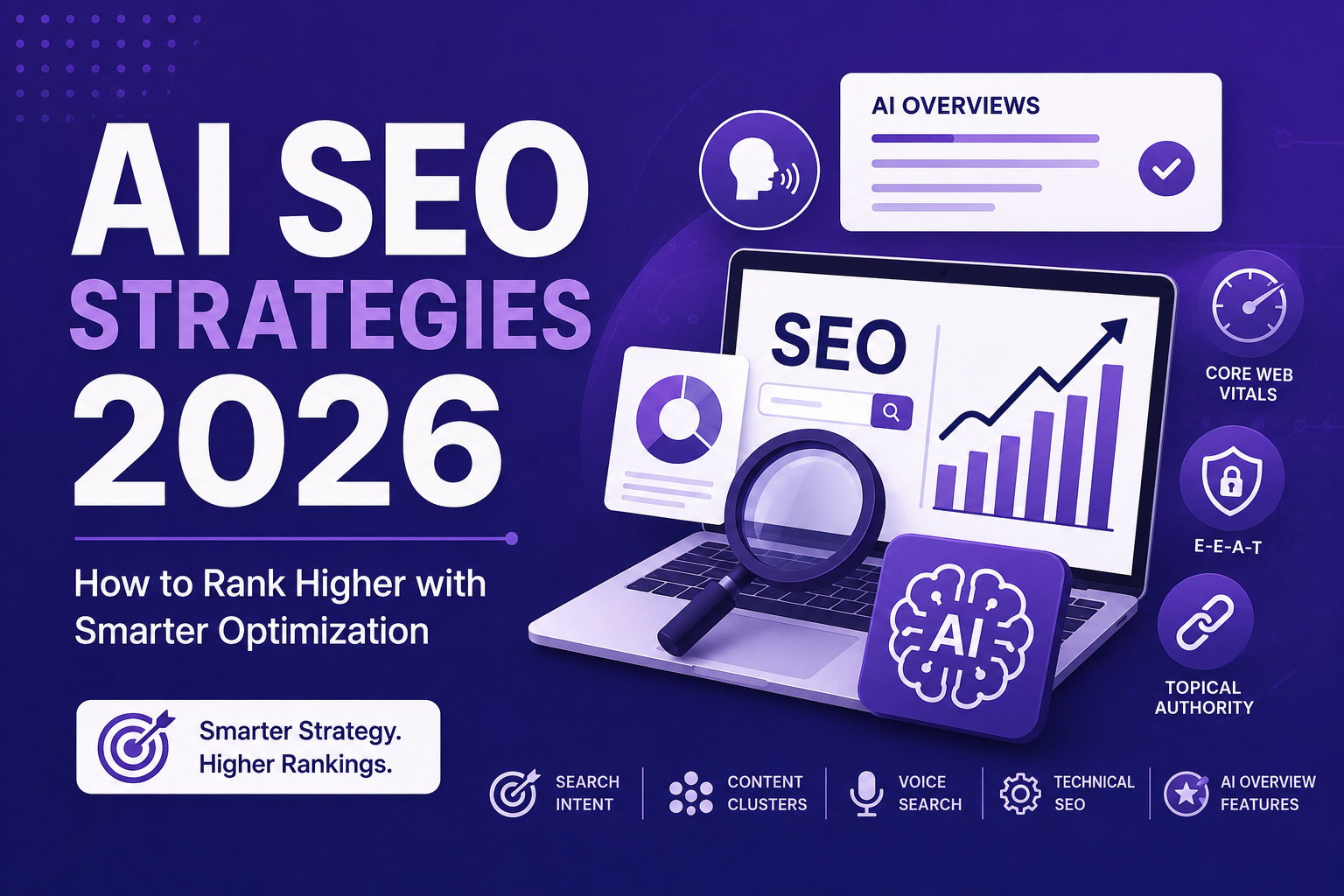
Search engine optimization has changed dramatically. In 2026, AI is not just a tool — it is the foundation of every successful SEO strategy. From how Google evaluates content to how users search, artificial intelligence is reshaping the rules. If you want your website to rank, you need to understand and apply the right AI SEO strategies for 2026.
Why AI Has Changed the SEO Game
Google’s search algorithms now rely heavily on AI models like Gemini and MUM (Multitask Unified Model) to understand search intent, evaluate content quality, and rank pages. This means old tricks like keyword stuffing or mass backlink building no longer work.
Today, Google rewards:
- Content that genuinely answers user questions
- Pages that demonstrate E-E-A-T (Experience, Expertise, Authoritativeness, Trustworthiness)
- Websites that load fast and provide a great user experience
If your SEO strategy hasn’t adapted, you’re likely losing rankings to competitors who have.
1. Focus on Search Intent, Not Just Keywords
The biggest shift in modern SEO is the move from keyword matching to intent matching. AI-powered search engines now understand why someone is searching, not just what they typed.
How to apply this:
- Before writing any content, ask: “What does the user actually want from this search?”
- Group your keywords by intent — informational, navigational, commercial, or transactional
- Structure your content to fully satisfy that intent from start to finish
Example: If someone searches “best AI writing tools,” they want a comparison, not a definition of AI writing. Give them a list, pros and cons, and a clear recommendation.
2. Use AI Tools to Speed Up Content Research
AI-powered SEO tools can now analyze thousands of top-ranking pages in seconds. Use them to find content gaps, identify related topics, and build topic clusters.
Top AI SEO tools worth using in 2026:
| Tool | Best For | Standout Feature |
|---|---|---|
| Surfer SEO | On-page optimization | Real-time content scoring |
| Semrush AI | Keyword research | Intent-based clustering |
| Clearscope | Content relevance | Semantic keyword suggestions |
| ChatGPT / Claude | Content drafting | Fast first drafts & outlines |
| RankMath AI | WordPress SEO | Automated schema & suggestions |
Use these tools to guide your content strategy, but always add your own expertise and original insights.
3. Build Topical Authority with Content Clusters
Random blog posts no longer work. Google’s AI now looks for topical authority — meaning your website should cover a subject deeply and completely.
How to build topical authority:
- Choose a core topic — e.g., “AI in Digital Marketing”
- Create a pillar page — a long, comprehensive guide on that topic
- Write cluster posts — smaller articles covering subtopics (e.g., “AI email marketing,” “AI for social media,” “AI content tools”)
- Link them together — internally link cluster posts back to the pillar page
This signals to Google that your site is a reliable, in-depth source on the subject.
4. Optimize for Voice and Conversational Search
With AI assistants becoming more common, more people are using natural language queries. Voice searches are longer, more conversational, and often phrased as questions.
Tips to optimize for voice search:
- Use question-based headings (e.g., “What is the best way to…”)
- Write in a natural, conversational tone
- Add an FAQ section to your articles (like this one!)
- Target featured snippets by giving direct, concise answers
5. Prioritize E-E-A-T in Every Piece of Content
Google’s quality raters look for Experience, Expertise, Authoritativeness, and Trustworthiness. AI can detect thin or generic content quickly.
How to demonstrate E-E-A-T:
- Add author bios with real credentials
- Link to credible sources and studies
- Share first-hand experience, not just summarized facts
- Keep content updated — outdated info hurts trust
- Get mentions or backlinks from reputable websites in your niche
6. Technical SEO Still Matters — AI Makes It Easier
No matter how good your content is, technical issues can kill your rankings. The good news is that AI tools now make technical audits faster and simpler.
Key technical SEO checks for 2026:
- Core Web Vitals (page speed, interactivity, visual stability)
- Mobile-first indexing — your site must work perfectly on phones
- Schema markup — helps AI understand your content structure
- Clean site architecture — easy for bots to crawl
- HTTPS security — non-negotiable in 2026
Use tools like Google Search Console, Screaming Frog, or Semrush’s Site Audit to find and fix issues.
7. Create Content That AI Overviews Can Feature
Google’s AI Overviews (formerly SGE) now appear at the top of many search results. Getting your content featured in these snippets can drive massive traffic.
How to get featured in AI Overviews:
- Write clear, factual, well-structured content
- Use numbered lists and bullet points — AI loves structured data
- Answer questions directly and concisely at the start of sections
- Back claims with data, stats, or expert quotes
Quick Comparison: Old SEO vs. AI SEO in 2026
| Factor | Old SEO (Pre-AI) | AI SEO 2026 |
|---|---|---|
| Keyword use | Exact match, high density | Natural, intent-based |
| Content goal | Hit a word count | Satisfy user intent fully |
| Link building | Quantity focused | Quality & relevance focused |
| Technical SEO | Basic (meta tags, sitemaps) | Core Web Vitals, schema, speed |
| Content depth | Broad coverage | Topical authority clusters |
| Search format | Text queries | Voice, visual, conversational |
Frequently Asked Questions (FAQs)
Q1: Can I use AI to write all my SEO content? You can use AI to draft and research content, but always edit it to add personal experience, accurate facts, and a human tone. Google can identify low-quality AI content that adds no real value.
Q2: How long should my blog posts be in 2026? Length should match intent. Informational articles often perform well between 1,000–2,000 words. More important than length is completeness — does your content fully answer the question?
Q3: Is keyword research still important? Absolutely. Keywords tell you what people are searching for. The difference now is you focus on topics and intent clusters rather than stuffing a single keyword repeatedly.
Q4: How do I rank on Google’s AI Overviews? Focus on clear, factual, well-structured content. Use headings, bullet points, and direct answers. Build authority in your niche with consistent, high-quality publishing.
Q5: How often should I update my content? Review key articles every 6–12 months. Update stats, refresh examples, and improve sections that no longer reflect current best practices.
Conclusion
AI SEO in 2026 is about working smarter, not just harder. The websites that win are those that genuinely help users, demonstrate real expertise, and keep up with how AI-driven search engines think.
To summarize the key takeaways:
- Match content to search intent, not just keywords
- Use AI tools to research and optimize — but keep the human touch
- Build topical authority through content clusters
- Optimize for voice search and conversational queries
- Strengthen your E-E-A-T signals on every page
- Fix technical issues and aim for AI Overview features
Start applying these strategies today, and you’ll be well ahead of most competitors still using outdated SEO playbooks.