

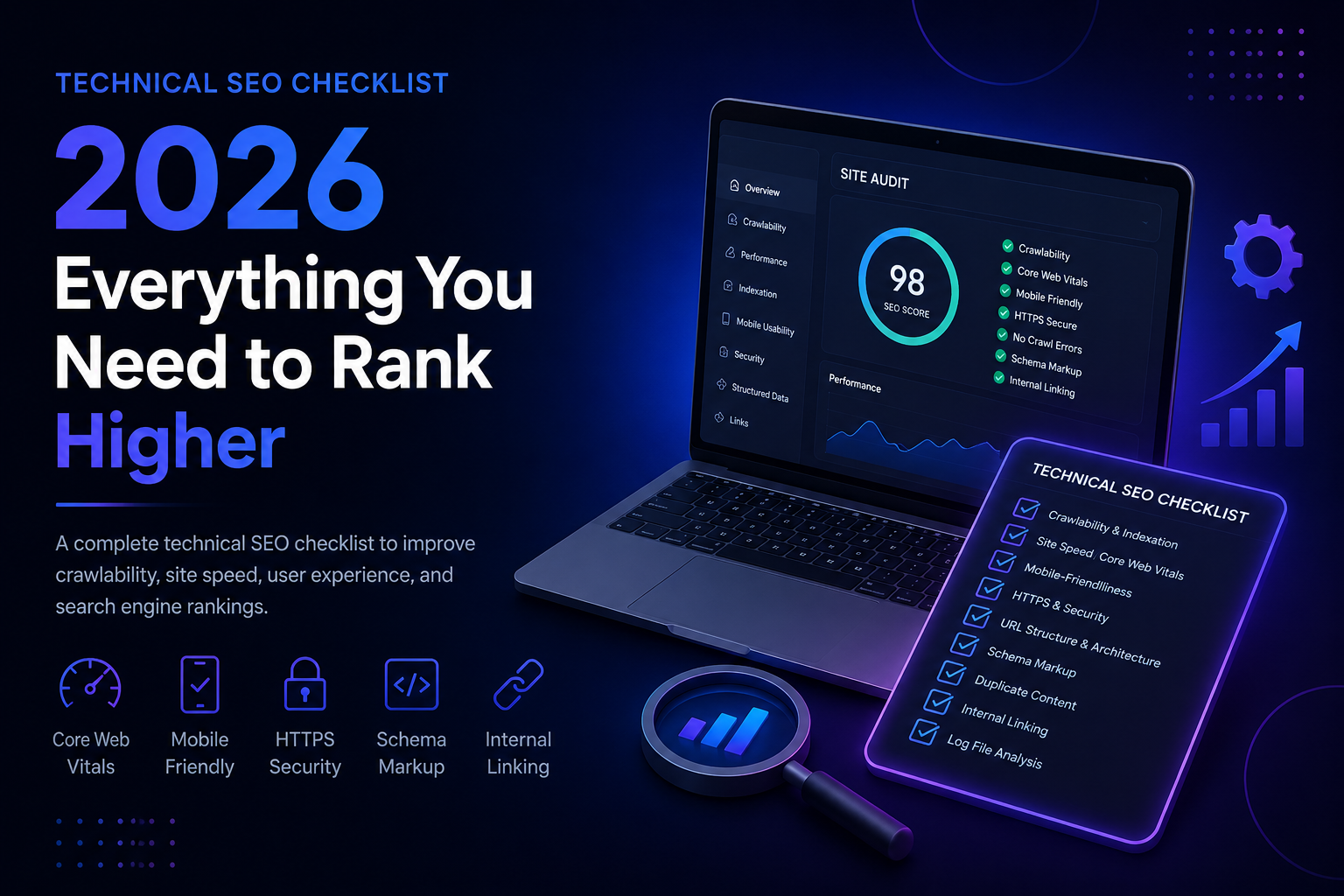
If your website isn’t ranking despite good content, technical issues might be the culprit. Search engines need to crawl, index, and understand your site before they can rank it. This guide walks you through a practical technical SEO checklist for 2026 — step by step, no jargon.
Why Technical SEO Still Matters in 2026
Google’s algorithm has grown smarter, but it still relies on technical signals to evaluate websites. Page experience, Core Web Vitals, mobile usability, and structured data are more important than ever. Skipping the technical foundation means leaving rankings on the table — no matter how great your content is.
1. Crawlability and Indexation
Before Google can rank your pages, it needs to find and read them.
What to check:
- robots.txt file — Make sure you’re not accidentally blocking important pages. Visit
yourdomain.com/robots.txtto review. - XML Sitemap — Submit an updated sitemap to Google Search Console. It should include all important URLs and exclude redirects or noindex pages.
- Crawl errors — Open Google Search Console → Coverage report. Fix any 404 errors or server errors promptly.
- Noindex tags — Audit pages with
<meta name="robots" content="noindex">. Only use this intentionally (e.g., thank-you pages, login pages).
2. Site Speed and Core Web Vitals
Google officially uses Core Web Vitals as a ranking factor. In 2026, the bar has gotten higher.
| Metric | What It Measures | Good Score |
|---|---|---|
| LCP (Largest Contentful Paint) | Loading speed of main content | Under 2.5 seconds |
| INP (Interaction to Next Paint) | Responsiveness to user input | Under 200ms |
| CLS (Cumulative Layout Shift) | Visual stability during load | Under 0.1 |
How to improve site speed:
- Compress images using WebP format
- Enable browser caching
- Use a Content Delivery Network (CDN)
- Minify CSS, JavaScript, and HTML files
- Remove unused plugins or scripts
Use Google PageSpeed Insights or GTmetrix to test your scores.
3. Mobile-Friendliness
Google uses mobile-first indexing — meaning it crawls and indexes the mobile version of your site first.
Checklist:
- [ ] Test your site using Google’s Mobile-Friendly Test
- [ ] Ensure text is readable without zooming
- [ ] Buttons and links have enough spacing for tap targets
- [ ] No horizontal scrolling on small screens
- [ ] Pop-ups don’t block main content on mobile
4. HTTPS and Site Security
A secure website builds trust with both users and search engines.
- Make sure your site runs on HTTPS, not HTTP
- Check that your SSL certificate is valid and not expired
- Ensure all internal links use HTTPS (no mixed content warnings)
- Set up 301 redirects from HTTP to HTTPS versions
You can check for mixed content issues using the browser’s developer tools (Console tab).
5. URL Structure and Site Architecture
A clean URL structure helps search engines understand your site hierarchy.
Best practices:
- Keep URLs short, descriptive, and lowercase (e.g.,
/technical-seo-checklist) - Use hyphens instead of underscores
- Avoid dynamic parameters where possible (e.g.,
?id=123) - Maintain a flat site structure — important pages should be reachable within 3 clicks from the homepage
- Fix broken internal links regularly
6. Structured Data (Schema Markup)
Schema markup helps Google understand your content and display rich results (star ratings, FAQs, breadcrumbs) in search.
Popular schema types in 2026:
- Article — for blog posts
- FAQPage — for FAQ sections
- Product — for ecommerce pages
- LocalBusiness — for local SEO
- HowTo — for step-by-step guides
Use Google’s Rich Results Test to validate your schema code. Tools like Rank Math or Yoast SEO can generate schema automatically.
7. Duplicate Content and Canonicalization
Duplicate content confuses search engines and splits your ranking signals.
How to fix it:
- Add a canonical tag (
<link rel="canonical">) on every page pointing to the preferred version - Choose one preferred domain format (www vs. non-www) and redirect the other
- Avoid publishing the same content across multiple URLs
- Handle pagination properly using
rel="next"andrel="prev"or canonical tags
8. Internal Linking
Internal links pass authority between pages and help users navigate your site.
Tips:
- Link from high-authority pages to pages you want to rank
- Use descriptive anchor text (not “click here”)
- Fix orphan pages — pages with no internal links pointing to them
- Avoid excessive links on a single page
9. Log File Analysis (Advanced)
If you run a large website, analyze server log files to see exactly which pages Googlebot is crawling — and how often.
- Identify pages being over-crawled (wasted crawl budget)
- Spot important pages being under-crawled
- Remove or noindex low-value pages to improve crawl efficiency
Tools: Screaming Frog Log File Analyser, Splunk, or custom scripts.
Quick Reference: Technical SEO Priority Table
| Priority | Task | Tool to Use |
|---|---|---|
| 🔴 High | Fix crawl errors and broken links | Google Search Console |
| 🔴 High | Improve Core Web Vitals scores | PageSpeed Insights |
| 🔴 High | Ensure HTTPS is active | SSL Checker |
| 🟡 Medium | Add/validate schema markup | Rich Results Test |
| 🟡 Medium | Fix duplicate content issues | Screaming Frog |
| 🟢 Low | Optimize site architecture | Sitebulb |
| 🟢 Low | Analyze log files | Log File Analyser |
FAQs About Technical SEO in 2026
Q1: How often should I run a technical SEO audit?
At minimum, run a full audit every quarter. For large or frequently updated websites, a monthly check is ideal.
Q2: What’s the most important technical SEO factor in 2026?
Core Web Vitals and mobile usability remain top priorities, along with crawlability. If Google can’t access your content, nothing else matters.
Q3: Do I need a developer for technical SEO?
Not always. Many issues — like sitemap submission, schema markup, and robots.txt edits — can be handled with plugins like Rank Math or Yoast. More complex issues like server configuration may require developer help.
Q4: What’s the difference between on-page SEO and technical SEO?
On-page SEO focuses on content, keywords, and meta tags. Technical SEO focuses on the infrastructure — how your site is built and how search engines interact with it. Both are necessary.
Q5: Is page speed still a ranking factor in 2026?
Yes. Page speed, especially as measured by Core Web Vitals, remains a confirmed Google ranking signal. Faster sites provide better user experience and rank better.
Conclusion
Technical SEO isn’t a one-time task — it’s an ongoing process. Use this checklist regularly to keep your website healthy, crawlable, and competitive in 2026. Start with the high-priority items: fix crawl errors, improve page speed, and secure your site with HTTPS. Then work your way through the rest.
A technically sound website gives all your other SEO efforts — content, backlinks, keyword strategy — the foundation they need to succeed.