

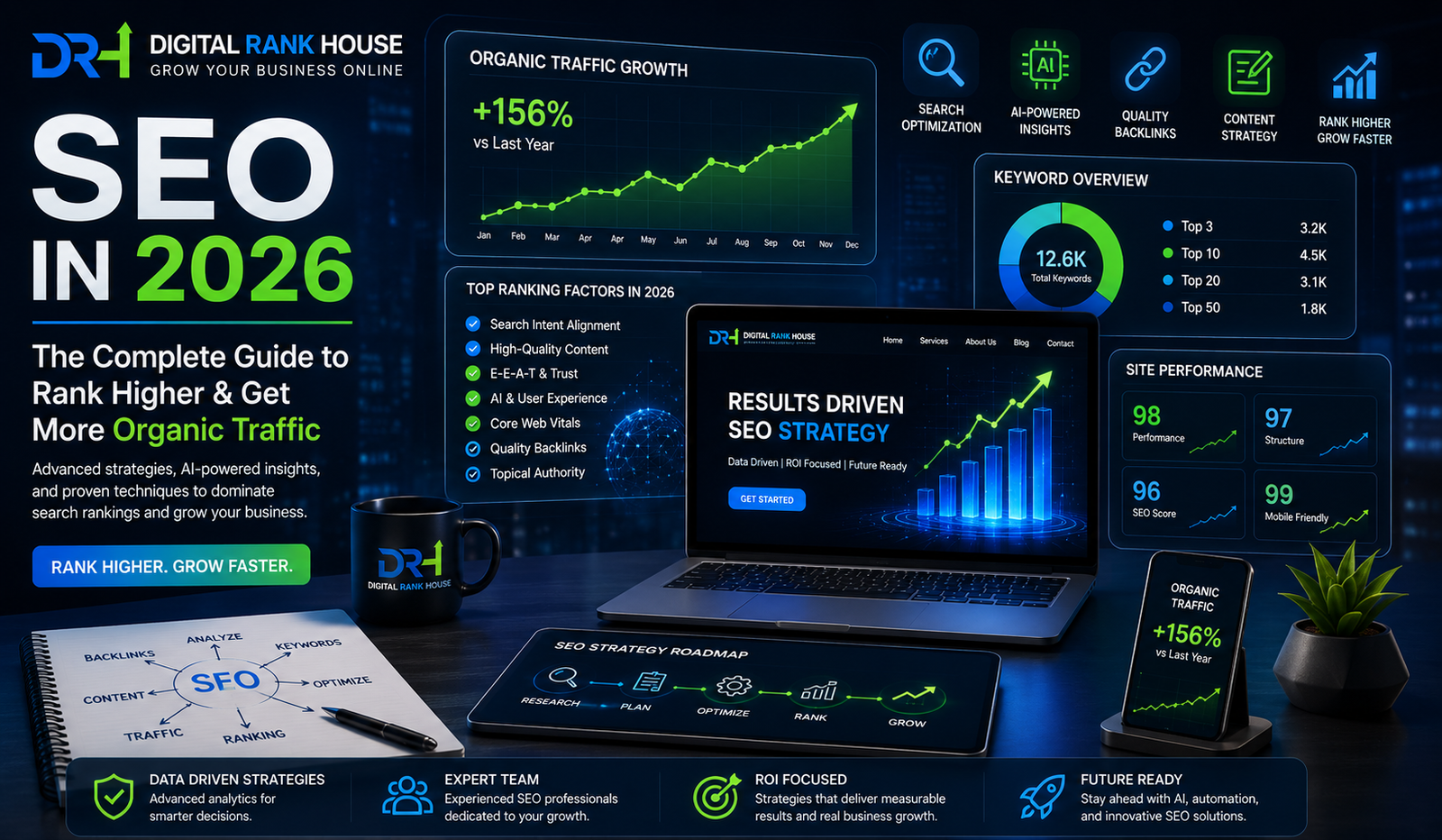
Search engine optimization has never stood still — and 2026 is no different. With Google rolling out AI-driven search experiences, user behavior shifting rapidly, and new ranking signals emerging every quarter, the way websites earn organic traffic looks very different from just two years ago.
If you want your website to rank, get clicks, and actually help your audience, this guide breaks down everything you need to know about SEO in 2026.
Why SEO Still Matters in 2026
Some people predicted SEO would “die” with the rise of AI. The reality? SEO is more important than ever — but the game has evolved.
- Search engines still drive billions of visits every day
- Organic traffic remains one of the highest-converting traffic sources
- AI-generated answers often pull from well-optimized, trusted websites
- Businesses that invest in SEO build long-term visibility without paying per click
The core goal has not changed: help users find the best answer to their question. What has changed is how search engines decide which content deserves the top spot.
The Biggest SEO Shifts in 2026
1. AI Overviews Are Now the New Normal
Google’s AI Overviews (formerly SGE) now appear on a large percentage of search results. This means users often get a summary at the top of the page — before they ever click a link.
What this means for you:
- Write content that answers questions directly and clearly
- Use structured data (schema markup) so Google can understand your content
- Focus on being cited inside AI Overviews, not just ranking below them
- Long-tail, conversational queries now matter more than ever
2. Search Intent Is the #1 Ranking Factor
Google has become remarkably good at understanding why someone is searching, not just what they typed.
There are four main types of search intent:
| Intent Type | What the User Wants | Example Query |
|---|---|---|
| Informational | Learn something | “how does SEO work” |
| Navigational | Find a specific site | “Ahrefs login” |
| Commercial | Compare options before buying | “best SEO tools 2026” |
| Transactional | Take action or buy | “buy SEO audit service” |
Tip: Before writing any page, ask yourself — what does the user actually want from this search? Match your content format and depth to that intent.
3. E-E-A-T Is Non-Negotiable
Google’s quality guidelines now heavily emphasize E-E-A-T:
- Experience — Has the author actually done this?
- Expertise — Do they know the subject deeply?
- Authoritativeness — Is the website a trusted source in its niche?
- Trustworthiness — Is the content accurate, safe, and honest?
How to improve E-E-A-T on your site:
- Add author bios with real credentials
- Link to original research and credible sources
- Keep your content updated with accurate information
- Earn backlinks from reputable websites in your industry
- Display clear contact information and a privacy policy
4. Voice and Conversational Search Are Growing
With smart speakers, phone assistants, and AI chat tools becoming everyday habits, more searches are now spoken out loud or typed in full sentences.
Optimize for conversational search by:
- Including FAQ sections in your articles
- Writing in natural, human language — avoid robotic keyword stuffing
- Targeting question-based keywords (who, what, how, why, when)
- Making sure your page loads fast on mobile devices
5. Core Web Vitals and Page Experience
Google’s page experience signals — especially Core Web Vitals — continue to influence rankings in 2026.
The three key metrics are:
| Metric | What It Measures | Good Score |
|---|---|---|
| LCP (Largest Contentful Paint) | Page load speed | Under 2.5 seconds |
| INP (Interaction to Next Paint) | Page responsiveness | Under 200ms |
| CLS (Cumulative Layout Shift) | Visual stability | Under 0.1 |
Quick wins for better page experience:
- Compress images before uploading
- Use a fast, reliable hosting provider
- Avoid intrusive pop-ups on mobile
- Enable browser caching and use a CDN
Content Strategy That Works in 2026
Write for Humans First, Algorithms Second
The biggest mistake website owners make is writing for robots. Google’s algorithms are now sophisticated enough to reward content that genuinely helps readers.
A strong article in 2026 should:
- Solve a real problem for the reader
- Be easy to skim (use headings, bullet points, short paragraphs)
- Include visuals where helpful (images, tables, infographics)
- Be comprehensive but not unnecessarily long
Topical Authority Over Single Keywords
Ranking for one keyword is no longer enough. Google rewards websites that cover an entire topic in depth — not just a single page.
Build topical authority by:
- Creating a cluster of related articles around one main topic
- Linking those articles together (internal linking)
- Covering beginner, intermediate, and advanced aspects of your niche
Technical SEO Checklist for 2026
Even the best content won’t rank if your website has technical issues. Here is a simple checklist:
- ✅ Submit an XML sitemap to Google Search Console
- ✅ Fix broken links and redirect errors (404s)
- ✅ Use HTTPS across your entire website
- ✅ Implement structured data (schema markup)
- ✅ Ensure your site is fully mobile-friendly
- ✅ Optimize your crawl budget for large websites
- ✅ Use canonical tags to avoid duplicate content
Link Building Still Works — But Quality Beats Quantity
Backlinks remain one of Google’s strongest ranking signals. However, the focus has fully shifted to quality over quantity.
What works in 2026:
- Guest posting on relevant, respected websites
- Earning mentions through original research or data
- Building relationships with journalists and bloggers
- Creating linkable assets (tools, guides, infographics)
What to avoid:
- Buying backlinks from link farms
- Participating in private blog networks (PBNs)
- Exchanging links excessively with unrelated websites
FAQs About SEO in 2026
Q: Is SEO still worth investing in for small businesses?
Absolutely. SEO provides one of the best long-term returns on investment for any business size. Once you rank, the traffic is essentially free.
Q: How long does it take to see SEO results in 2026?
Most websites see noticeable improvements within 3 to 6 months of consistent effort. Competitive niches may take longer.
Q: Does social media affect SEO rankings?
Social media does not directly influence rankings, but it helps amplify content, earn backlinks, and build brand awareness — all of which support SEO indirectly.
Q: How often should I update old blog posts?
Review your top-performing articles at least once every 6 to 12 months. Refresh outdated information, add new data, and improve weak sections.
Q: Do I still need to do keyword research in 2026?
Yes — but the focus has shifted. Instead of obsessing over exact-match keywords, focus on understanding topics and the questions your audience is actually asking.
Conclusion
SEO in 2026 is smarter, more user-focused, and more competitive than ever before. The websites that win are not the ones that game the algorithm — they are the ones that genuinely serve their audience with helpful, trustworthy, and well-structured content.
To summarize what matters most right now:
- Understand and match search intent on every page
- Build E-E-A-T through real expertise and credibility
- Optimize for AI Overviews and conversational search
- Keep your technical foundation clean and fast
- Build topical authority, not just individual pages
- Earn quality backlinks through valuable content
Start with one area, be consistent, and your organic visibility will grow. SEO rewards patience and genuine effort — and that has not changed at all.