

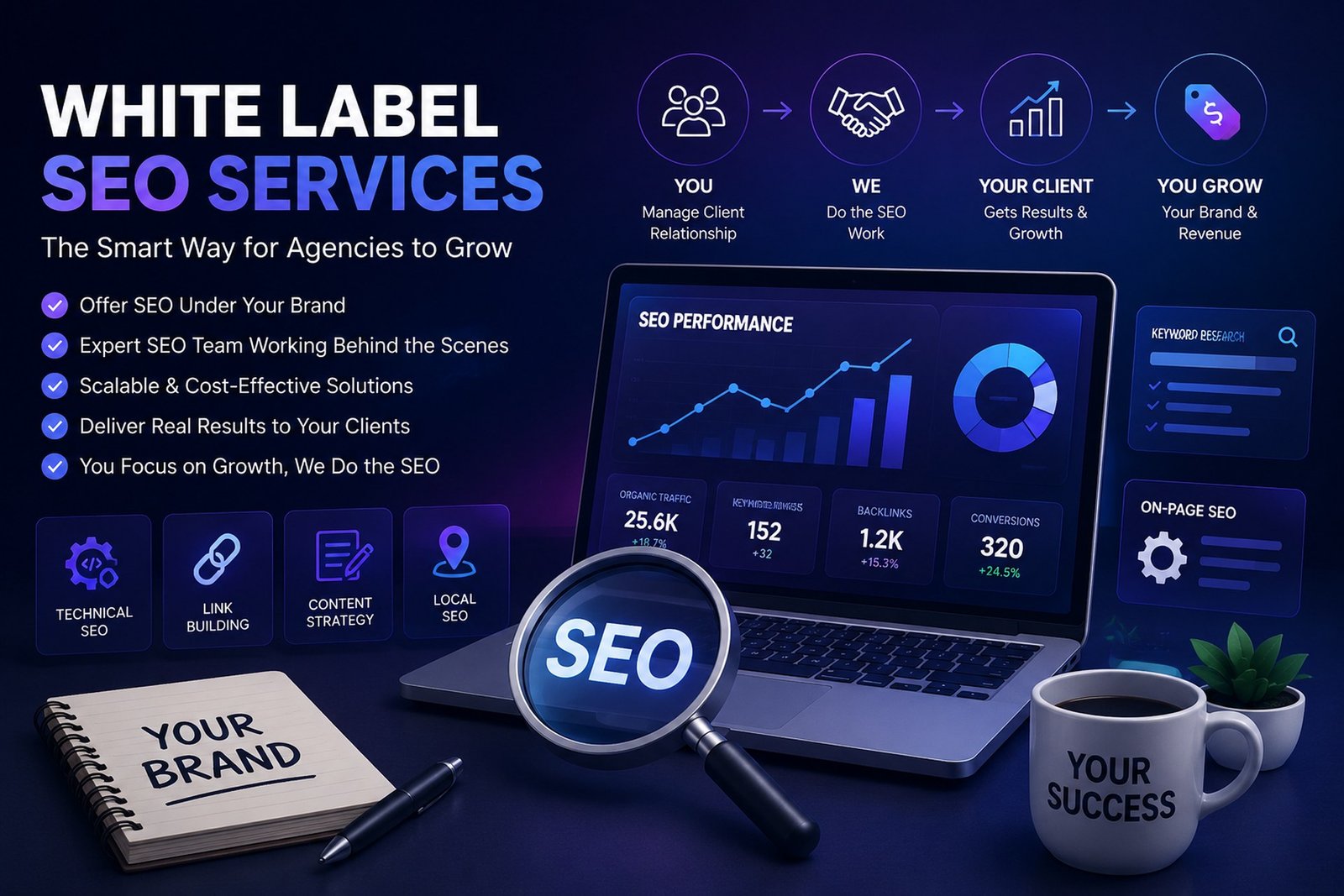
If you run a digital marketing agency, web design firm, or IT company, you have probably been asked by clients: “Can you also handle our SEO?” White label SEO services let you say yes — without hiring an in-house SEO team.
This guide explains everything you need to know: what white label SEO is, how it works, who it is for, and how to choose the right provider.
What Are White Label SEO Services?
White label SEO services are SEO solutions provided by a third-party agency that you resell under your own brand name. The provider does all the technical work behind the scenes. Your client only ever sees your logo, your reports, and your name.
Think of it like a restaurant that buys bread from a bakery but sells it as their own. The end customer never knows who baked it — and they do not need to.
Common Services Included
- Keyword research and strategy
- On-page SEO optimization
- Link building and outreach
- Technical SEO audits
- Local SEO management
- Content creation and optimization
- Monthly performance reports (white-labeled)
How Does White Label SEO Work? (Step-by-Step)
Here is how the process typically flows from start to finish:
- You sign up with a white label SEO provider and agree on pricing and scope.
- Your client contacts you asking for SEO services.
- You collect requirements from your client (website URL, goals, target audience, budget).
- You pass the brief to your white label partner.
- The provider executes the work — audits, content, link building, reporting.
- You receive branded reports and deliverables with your logo.
- You deliver results to your client as if your team did it.
- You invoice the client at your own markup. You keep the profit margin.
The client relationship stays with you. The white label provider stays invisible.
Who Should Use White Label SEO?
White label SEO is a smart solution for several types of businesses:
- Digital marketing agencies that want to offer SEO without the overhead of an internal team
- Web design and development agencies looking to upsell ongoing SEO services
- PPC or social media agencies expanding their service menu
- Freelancers who want to take on bigger SEO projects than they can handle alone
- IT and SaaS companies bundling SEO into their product offerings
If client demand for SEO is there but your capacity is not, white labeling fills the gap.
Key Benefits of White Label SEO
| Benefit | What It Means for You |
|---|---|
| Scalability | Take on more clients without hiring new staff |
| Cost Efficiency | No salaries, tools, or training costs for an SEO team |
| Expertise on Demand | Access seasoned SEO specialists immediately |
| Brand Consistency | All work is delivered under your brand |
| Faster Turnaround | Dedicated provider teams work faster than stretched in-house staff |
| Focus on Core Work | You focus on client relationships and sales |
White Label SEO vs. In-House SEO vs. Outsourcing
| Factor | White Label SEO | In-House SEO | Direct Outsourcing |
|---|---|---|---|
| Cost | Medium (reseller margin) | High (salaries + tools) | Low to Medium |
| Brand Control | Full | Full | None |
| Scalability | High | Low | Medium |
| Speed to Start | Fast | Slow (hiring takes time) | Fast |
| Client Visibility | Hidden provider | Your team | Client sees third party |
| Best For | Agencies, resellers | Large businesses | Solo operators |
What to Look for in a White Label SEO Provider
Not all providers are equal. Before you commit, check these key factors:
1. Proven Track Record
Ask for case studies and client results. A good provider will have data to back their claims — organic traffic improvements, ranking history, and ROI figures.
2. Transparent Reporting
Your clients will ask questions. Make sure the provider delivers detailed, easy-to-understand reports that you can brand and share confidently.
3. White-Hat Techniques Only
Avoid providers that use spammy link building, keyword stuffing, or black-hat tactics. These may deliver quick wins but will damage your client’s website — and your reputation — in the long run.
4. Dedicated Account Support
You need a point of contact who understands your clients’ needs and communicates clearly. Slow or vague communication is a red flag.
5. Flexible Packages
Look for providers offering tiered packages so you can serve clients of different sizes and budgets.
6. NDA and Confidentiality Agreements
A professional white label partner will happily sign agreements to protect your client relationships and brand identity.
How to Price White Label SEO Services
Pricing depends on your market, client size, and the services included. A common approach:
- Cost-plus pricing: Take the provider’s cost and add a 30–50% markup
- Value-based pricing: Charge based on the results and ROI you deliver
- Package pricing: Bundle services into tiered plans (Basic, Standard, Premium)
For example, if your white label provider charges $500/month for a local SEO package, you might resell it at $800–$1,000/month to your client.
Common Mistakes to Avoid
- Not vetting your provider — poor SEO work reflects on you, not the provider
- Overpromising results — SEO takes time; set realistic timelines (3–6 months minimum)
- Ignoring client communication — stay involved even when a provider handles the work
- Choosing only on price — cheapest is rarely best in SEO
- Skipping contracts — always have written agreements with both your client and provider
Frequently Asked Questions (FAQs)
Q1: Will my client know I am using a white label SEO provider?
No. All reports, communication materials, and deliverables are branded under your agency’s name. The provider remains completely invisible.
Q2: Is white label SEO ethical?
Yes, absolutely. White labeling is a standard and widely accepted business practice across many industries, including marketing, software, and manufacturing.
Q3: How long does it take to see SEO results?
Typically 3 to 6 months for noticeable improvements, depending on competition level, website age, and the scope of work. Always communicate this timeline to your clients upfront.
Q4: Can I customize the SEO strategy for each client?
Yes. Most white label providers work to a brief you provide. You can tailor keyword targets, content tone, local vs. national focus, and more for each client.
Q5: What if my client wants to speak directly to the SEO team?
This depends on your agreement with the provider. Many agencies handle this by positioning the white label team as “our in-house specialists.” Some providers also offer white-labeled client calls under your brand.
Q6: Do I need SEO knowledge to resell these services?
Basic understanding helps, but you do not need to be an expert. Your provider handles execution. You need to manage the client relationship and communicate results clearly.
Conclusion
White label SEO services are one of the smartest ways for agencies to grow revenue, expand their service offering, and deliver real value to clients — without the cost and complexity of building an in-house SEO team.
The key is choosing a trustworthy, transparent provider who does quality work and stays behind the scenes. When that partnership works well, your clients get better rankings, your agency earns more, and everyone wins.
If you are ready to scale your agency and add a reliable SEO revenue stream, exploring white label SEO is a logical next step.