

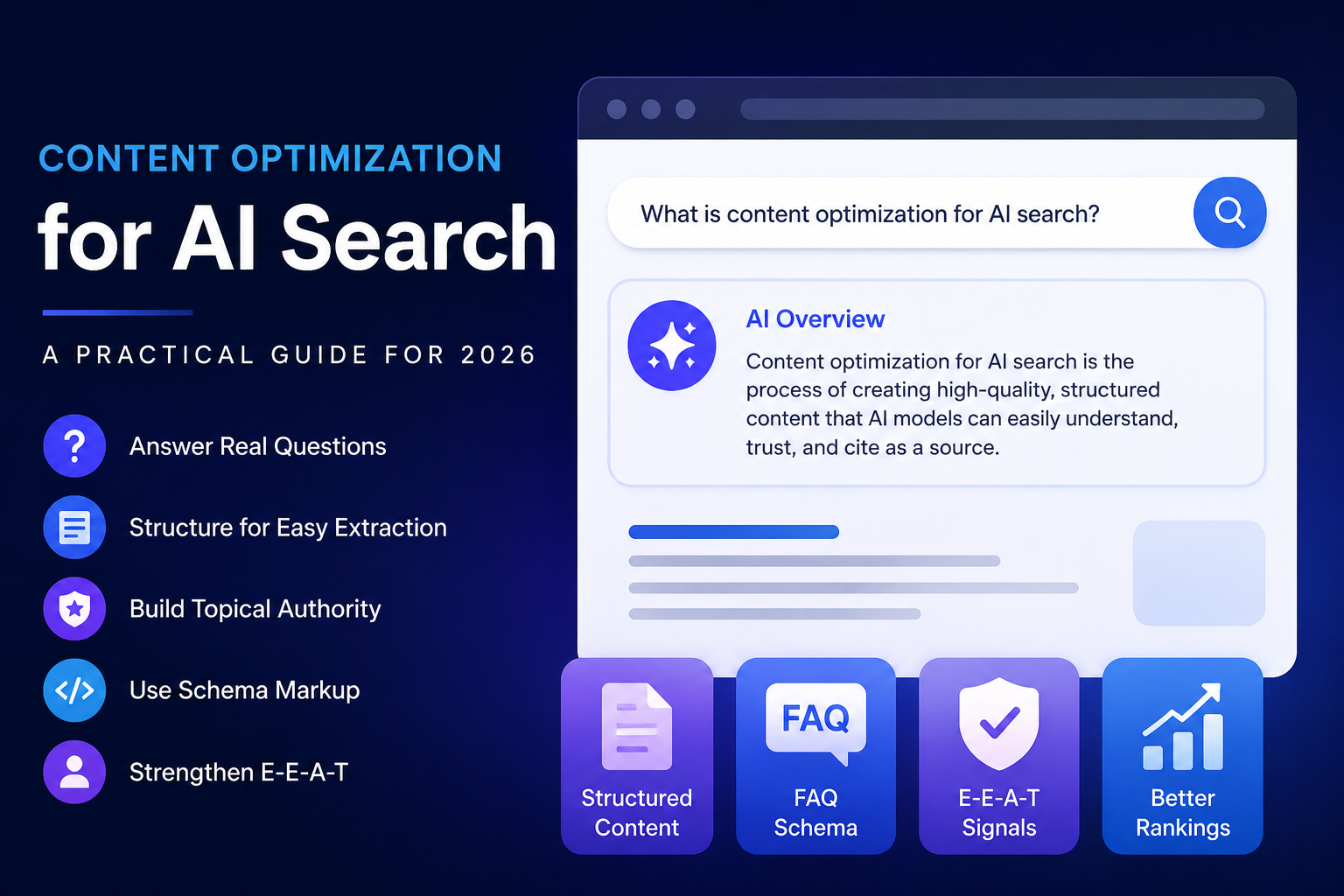
Introduction
Search has changed. People are no longer just typing keywords into Google — they’re asking full questions to AI tools like ChatGPT, Google’s AI Overviews, Perplexity, and Copilot. If your content isn’t optimized for how AI systems read and answer, you’re missing a growing share of search traffic.
This guide breaks down exactly how to optimize your content for AI-powered search in 2026 — in plain, actionable steps.
How AI Search Is Different From Traditional Search
Traditional search returns a list of links. AI search returns a direct answer — often pulling from a single source or summarizing multiple pages.
This changes the game completely. Instead of just ranking on page one, you now need your content to be the source AI tools trust and cite.
| Traditional Search | AI Search |
|---|---|
| Returns 10 blue links | Returns a direct answer |
| User clicks through to site | Answer is given on the spot |
| Keyword match matters most | Context and clarity matter most |
| Ranks pages | Selects trusted sources |
| Focuses on backlinks | Focuses on authority and structure |
Understanding this shift is the first step to optimizing for it.
1. Write for Questions, Not Just Keywords
AI search is conversational. Users ask things like “What’s the best way to speed up my website?” not just “website speed tips.”
How to adapt your content:
- Identify the real questions your audience is asking
- Use tools like Answer the Public, AlsoAsked, or Google’s People Also Ask section
- Write content that directly answers those questions — not around them
- Use question-based subheadings (e.g., “How does schema markup help SEO?”)
The more directly your content answers a specific question, the more likely AI tools are to pull from it.
2. Structure Your Content for Easy Extraction
AI systems scan content and pull the most relevant section. If your writing is dense or unorganized, it gets skipped.
Content structure best practices:
- Use clear H2 and H3 headings that reflect what each section answers
- Write a direct answer in the first 1–2 sentences of each section
- Follow the answer with supporting detail
- Use bullet points and numbered lists — AI systems love structured data
- Keep paragraphs short (2–4 sentences max)
Think of each section as a self-contained answer that could stand alone.
3. Build Topical Authority
AI tools don’t just look at one article — they evaluate your site’s overall expertise on a topic. This is called topical authority.
How to build it:
- Create a content cluster — one main “pillar” page supported by several related articles
- Cover a topic from multiple angles (beginner guides, advanced tips, comparisons, FAQs)
- Internally link related articles together
- Avoid publishing thin or shallow content just to fill gaps
For example, if your site covers SEO, you shouldn’t just have one SEO article. You need pages on on-page SEO, technical SEO, local SEO, link building, and so on — all connected.
4. Use Clear, Simple Language
AI models are trained to understand natural language — but they favor content that is clear, confident, and easy to parse.
Writing tips:
- Use short sentences and common words
- Avoid vague phrases like “it depends” without explanation
- Be direct: say “You should use HTTPS” not “It might be a good idea to consider HTTPS”
- Define technical terms the first time you use them
- Write in active voice whenever possible
Simple language isn’t dumbing things down — it’s making your content accessible and AI-friendly at the same time.
5. Add Structured Data (Schema Markup)
Schema markup is code you add to your pages that tells search engines — and AI systems — what your content is about.
Most useful schema types for AI search:
| Schema Type | Best Used For |
|---|---|
| FAQPage | FAQ sections on any page |
| Article | Blog posts and news content |
| HowTo | Step-by-step guides |
| Product | Ecommerce product pages |
| Review | Testimonials and review pages |
| BreadcrumbList | Site navigation structure |
Adding schema helps AI tools understand your content’s purpose — not just its words. Use plugins like Rank Math or Schema Pro to implement it without coding.
6. Strengthen E-E-A-T Signals
Google and AI tools alike prioritize content from sources that demonstrate Experience, Expertise, Authoritativeness, and Trustworthiness — known as E-E-A-T.
How to improve E-E-A-T:
- Add a detailed author bio with credentials and real experience
- Link to credible external sources (studies, official sites, reputable publications)
- Keep your content updated — add a “Last updated” date
- Earn backlinks from trusted websites in your niche
- Display trust signals: privacy policy, contact page, about page, and real reviews
AI systems are increasingly trained to avoid citing unreliable or anonymous content. Your credibility signals matter more than ever.
7. Optimize for Featured Snippets and AI Overviews
Google’s AI Overviews pull from the same content that ranks for featured snippets. Winning one often means winning both.
How to target featured snippets:
- Answer the target question in 40–60 words, directly below the question heading
- Use definition-style answers for “What is” queries
- Use numbered lists for “How to” queries
- Use tables for comparison queries
- Make sure your page already ranks in the top 10 for the target keyword
If your content is already structured well (as covered above), you’re halfway there.
8. Keep Content Fresh and Accurate
AI tools are trained on data — but the best AI search systems also pull live or recently indexed content. Outdated information hurts your chances of being cited.
Content freshness checklist:
- [ ] Review and update older articles every 3–6 months
- [ ] Update statistics with the most recent data available
- [ ] Remove or fix any broken links
- [ ] Add new sections as topics evolve
- [ ] Change the publish/update date after meaningful revisions
A well-maintained article signals reliability — to both users and AI systems.
AI Search Optimization: Quick-Reference Checklist
| Task | Why It Matters |
|---|---|
| Write question-based headings | Matches conversational search queries |
| Structure content with clear H2/H3s | Helps AI extract relevant sections |
| Add FAQ schema markup | Increases chance of rich result display |
| Build topical content clusters | Establishes subject authority |
| Update content regularly | Signals freshness and reliability |
| Strengthen author E-E-A-T | Builds source credibility |
| Target featured snippet format | Aligns with AI Overview sourcing |
FAQs About Content Optimization for AI Search
Q1: Does optimizing for AI search hurt traditional SEO?
No — in fact, they overlap heavily. Clear structure, strong E-E-A-T, and well-answered questions help both traditional rankings and AI citations.
Q2: Which AI search platforms should I optimize for?
Focus on Google AI Overviews first (largest user base), then Perplexity and Bing Copilot. The same content principles apply across all of them.
Q3: How long should my content be for AI search?
Depth matters more than length. A focused 1,000-word article that fully answers a question outperforms a bloated 3,000-word piece that rambles. Aim for completeness, not word count.
Q4: Can small websites compete in AI search?
Yes. AI tools look for the best answer, not just the biggest domain. A well-structured, authoritative article on a niche site can absolutely be cited — especially if large sites haven’t covered that specific angle.
Q5: Is keyword research still relevant for AI search?
Yes, but the focus shifts. Instead of exact-match keywords, research the questions and topics your audience cares about. Intent matters more than keyword density.
Conclusion
AI search isn’t replacing SEO — it’s evolving it. The fundamentals still apply: create helpful, well-structured content that genuinely answers your audience’s questions. But now you also need to think about how AI systems read, extract, and cite your pages.
Start with clear structure, honest expertise, and content that’s built around real questions. Do that consistently, and your site becomes a source that both users and AI tools learn to trust.