

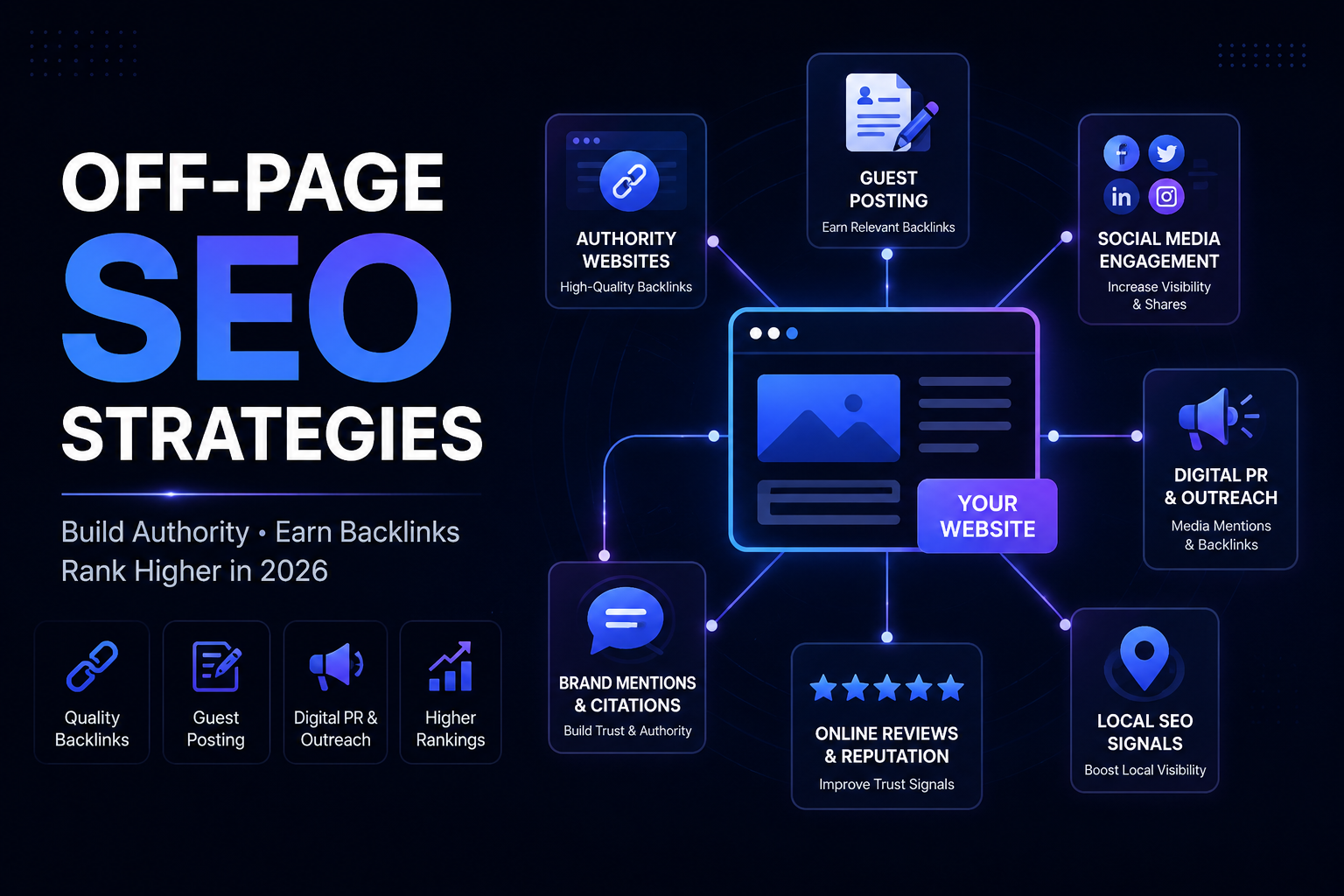
Introduction
If you have ever wondered why some websites rank on top of Google even when their content isn’t perfect, the answer usually lies outside their website. This is called off-page SEO. While on-page SEO deals with what’s inside your website, off-page SEO deals with everything happening outside it — backlinks, brand mentions, social signals, and online reputation.
In this guide, we will break down the most effective off-page SEO strategies in simple, easy-to-follow language, so you can start applying them to your own website today.
What Is Off-Page SEO?
Off-page SEO refers to all the actions taken outside your own website to improve its position in search engine results. It mainly focuses on building trust, authority, and relevance through external sources like other websites, social media platforms, and online communities.
Think of it like your reputation in real life. If many trustworthy people vouch for you, others naturally trust you more. Search engines work the same way — when reputable sites link to or talk about your website, Google sees it as a vote of confidence.
Why Off-Page SEO Matters
Search engines like Google use hundreds of ranking factors, but authority and trust signals from outside your site carry significant weight. Here’s why off-page SEO is important:
- It builds domain authority and trustworthiness
- It helps search engines understand your site’s relevance and popularity
- It drives referral traffic from other websites
- It improves brand visibility and recognition
- It supports long-term, sustainable rankings (not just quick wins)
Top Off-Page SEO Strategies That Actually Work
Let’s go through the most reliable strategies step by step.
1. Build High-Quality Backlinks
Backlinks remain one of the strongest ranking signals. However, quality matters far more than quantity.
How to build good backlinks:
- Reach out to relevant blogs in your niche for guest posting
- Create original research, data, or infographics that others want to cite
- Fix broken links on other websites and suggest your content as a replacement
- List your business on trusted, relevant directories
- Earn links naturally by publishing genuinely useful content
Avoid:
- Buying links in bulk
- Getting links from spammy or unrelated websites
- Using the same anchor text repeatedly
2. Guest Blogging
Writing articles for other reputable websites in your industry helps you earn backlinks and exposes your brand to a new audience.
Steps to do this effectively:
- Find blogs in your niche with good domain authority
- Pitch unique, value-driven topic ideas
- Write helpful, non-promotional content
- Include a natural link back to your website
- Build a long-term relationship with the site editor
3. Social Media Engagement
While social signals are not a direct ranking factor, they help increase content visibility, which can indirectly lead to more backlinks and traffic.
- Share your blog posts consistently across platforms
- Engage with comments and messages
- Join niche-specific groups and communities
- Encourage social sharing with simple share buttons
4. Influencer and Industry Outreach
Partnering with influencers or industry experts can amplify your content’s reach.
- Identify micro-influencers in your niche (they often have higher engagement)
- Offer free products, exclusive data, or collaboration opportunities
- Ask for honest reviews or mentions
- Build relationships before asking for backlinks
5. Online Reputation Management
Search engines also consider how your brand is perceived online.
- Respond to reviews on Google Business Profile, Trustpilot, etc.
- Monitor brand mentions using tools like Google Alerts
- Address negative feedback professionally
- Encourage satisfied customers to leave reviews
6. Forum and Community Participation
Platforms like Quora, Reddit, and niche forums allow you to build authority by answering questions genuinely.
- Provide helpful, detailed answers (not promotional spam)
- Link to your content only when truly relevant
- Build a consistent, trustworthy profile over time
7. Local SEO Signals (For Local Businesses)
If you run a local business, off-page local SEO is essential.
- Optimize and verify your Google Business Profile
- Get listed in local directories (Yelp, Yellow Pages, etc.)
- Collect consistent NAP (Name, Address, Phone) information across platforms
- Gather local customer reviews
8. Content Marketing and Digital PR
Creating shareable, link-worthy content naturally attracts attention from journalists and bloggers.
- Publish original studies, surveys, or case studies
- Create visually appealing infographics
- Pitch your content to relevant news outlets and bloggers
- Use HARO (Help a Reporter Out) type platforms to get featured
On-Page SEO vs Off-Page SEO: Quick Comparison
| Factor | On-Page SEO | Off-Page SEO |
|---|---|---|
| Focus Area | Inside your website | Outside your website |
| Examples | Title tags, content, internal links | Backlinks, social shares, reviews |
| Control Level | Fully controlled by you | Partially controlled (depends on others) |
| Main Goal | Relevance and readability | Authority and trust |
| Time to Show Results | Faster | Usually slower, long-term |
Common Off-Page SEO Mistakes to Avoid
| Mistake | Why It’s Harmful |
|---|---|
| Buying backlinks in bulk | Can trigger Google penalties |
| Ignoring link relevance | Reduces link value and trust |
| Overusing exact-match anchor text | Looks unnatural to search engines |
| Neglecting brand mentions | Misses easy authority-building opportunities |
| Focusing only on quantity | Quality links matter far more than volume |
How Long Does Off-Page SEO Take to Show Results?
Off-page SEO is a long-term strategy. While some improvements in traffic or rankings may appear within a few weeks, building real domain authority and trust typically takes three to six months or longer, depending on your niche competition and consistency.
Frequently Asked Questions (FAQs)
Q1. What is the difference between on-page and off-page SEO?
On-page SEO involves optimizing elements within your website, such as content and meta tags. Off-page SEO involves building authority through external actions like backlinks and brand mentions.
Q2. Are backlinks still important in 2026?
Yes, backlinks remain a major ranking factor, but search engines now prioritize quality, relevance, and natural link-building over sheer quantity.
Q3. Can social media really impact SEO rankings?
Social media doesn’t directly affect rankings, but it increases content visibility, which can lead to more backlinks, traffic, and brand awareness — all of which support SEO indirectly.
Q4. How many backlinks do I need to rank higher?
There’s no fixed number. A few high-quality, relevant backlinks are far more valuable than hundreds of low-quality ones.
Q5. Is guest blogging still effective for SEO?
Yes, as long as you focus on reputable websites and provide genuine value rather than purely promotional content.
Conclusion
Off-page SEO is all about building trust, authority, and credibility beyond your website. By focusing on quality backlinks, guest blogging, social engagement, reputation management, and community participation, you can steadily improve your search rankings over time.
Remember, off-page SEO is not about shortcuts — it’s about building genuine relationships and earning recognition in your industry. Stay consistent, prioritize quality over quantity, and the results will follow naturally.