
Search engine optimization has changed a lot in the last few years. In 2026, it is not just about placing keywords on a page. It is about showing up as the trusted answer — whether on Google, an AI Overview, or a voice assistant.
If you are new to SEO or want to update your knowledge, this guide breaks down the core building blocks you need in plain, simple language.
What Is SEO and Why Does It Still Matter?
SEO stands for Search Engine Optimization. It is the process of improving your website so that search engines like Google show it to more people.
Even with AI-powered search, social media, and chatbots growing fast, SEO is still very much alive. Google holds over 90% market share in search. And now, optimizing for Google also helps your content show up in tools like ChatGPT and Perplexity, since many of them are built on Google’s infrastructure.
The goal has shifted slightly though. It is no longer just about ranking on page one. It is about becoming the answer that AI systems and search engines trust.
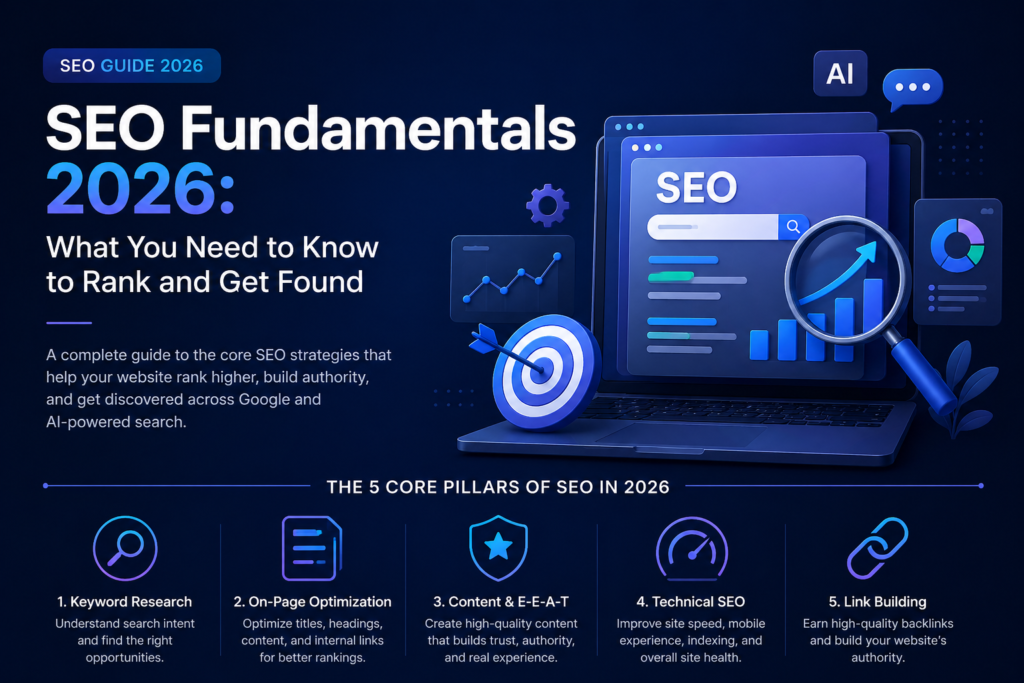
The 5 Core Pillars of SEO in 2026
1. Keyword Research (Still Important, but Smarter)
Keywords are still the foundation. But in 2026, it is less about stuffing one phrase everywhere and more about understanding what your audience is really looking for.
How to do smart keyword research:
- Start with a broad topic, then find related questions people ask
- Focus on search intent — are users looking to learn, compare, or buy?
- Use tools like Google Search Console, Ahrefs, or Semrush
- Look for long-tail keywords (3–5 word phrases) with clear intent
- Group related keywords into topic clusters instead of targeting each one separately
The 4 types of search intent:
| Intent Type | What the User Wants | Example |
|---|---|---|
| Informational | Learn something | “What is on-page SEO?” |
| Navigational | Find a specific site | “Google Search Console login” |
| Commercial | Compare before buying | “Best SEO tools 2026” |
| Transactional | Ready to take action | “Buy Ahrefs subscription” |
2. On-Page Optimization
On-page SEO means making each page on your website clear, relevant, and easy to read — for both users and search engines.
Key on-page elements to check:
- Title tag — Include your main topic, keep it under 60 characters
- Meta description — A short 150-character summary that tells users what the page is about
- Headings (H1, H2, H3) — Use them to organize content logically
- URL structure — Keep it short and descriptive (e.g.,
/seo-fundamentals-2026) - Internal links — Link to other helpful pages on your website
- Image alt text — Describe images so search engines understand them
3. Content Quality and E-E-A-T
Google in 2026 uses a framework called E-E-A-T to judge content quality. This stands for:
- Experience — Have you actually used or tried what you are writing about?
- Expertise — Do you know your topic deeply?
- Authoritativeness — Are you a recognized voice in your field?
- Trustworthiness — Is your site safe, honest, and accurate?
How to improve E-E-A-T on your blog:
- Add an author bio with real credentials
- Cite reliable sources (studies, official data, expert quotes)
- Keep your content up to date
- Include personal experience or case studies
- Use HTTPS and have a clear privacy policy
Content that demonstrates real experience tends to rank higher and get cited by AI systems in their summaries.
4. Technical SEO
Technical SEO ensures that search engines can actually find, read, and index your website properly. Think of it as the behind-the-scenes work that makes everything else function.
Technical SEO basics for 2026:
| Technical Factor | Why It Matters |
|---|---|
| Page speed | Slow pages hurt rankings and frustrate users |
| Mobile-friendliness | Over 65% of web traffic is from mobile devices |
| HTTPS | Secure sites are now the standard (91%+ adoption) |
| Core Web Vitals | Google measures loading, interactivity, and visual stability |
| Clean URL structure | Easier for bots and users to navigate |
| XML sitemap | Helps search engines find all your pages |
| Robots.txt | Controls which pages bots can crawl |
Steps to improve technical SEO:
- Run a free audit with Google Search Console or Screaming Frog
- Fix broken links (404 errors)
- Compress large images
- Enable browser caching and use a CDN (Content Delivery Network)
- Make sure your site loads in under 3 seconds on mobile
5. Link Building and Authority
Backlinks — when other websites link to yours — are still one of the strongest signals that your site is trustworthy and worth ranking.
What works in 2026:
- Getting links from relevant, high-quality websites in your niche
- Writing guest posts on respected blogs
- Creating original research, tools, or statistics that others want to cite
- Building real relationships in your industry
What to avoid:
- Buying cheap backlinks from shady directories
- Link farms and private blog networks (PBNs)
- Over-optimized anchor text that looks unnatural
One strong backlink from a trusted site is worth more than 50 low-quality ones.
AI and SEO: The New Reality
One of the biggest changes in 2026 is the rise of AI Overviews on Google. These are AI-generated answer boxes that appear at the top of search results — and they now reach over 2 billion monthly users.
This means some users get their answer without ever clicking your link. But the upside is that if your content is well-structured and trustworthy, AI systems will cite your site as a source.
How to optimize for AI-powered search:
- Use clear headings, bullet points, and short paragraphs
- Answer specific questions directly and concisely
- Add structured data (schema markup) to your pages
- Build your brand’s reputation across multiple platforms
- Keep your content fresh and factually accurate
Quick Comparison: Old SEO vs. SEO in 2026
| Old Approach | 2026 Approach |
|---|---|
| Target single keywords | Build topic clusters |
| Focus on Google only | Optimize for Google, AI tools, voice search |
| More content = more traffic | Quality and depth over quantity |
| Backlinks from anywhere | Authority links from relevant sources |
| Keyword density matters | Search intent and E-E-A-T matter more |
| Rank on page one | Get cited as the trusted answer |
Frequently Asked Questions (FAQs)
Q: Is SEO still worth learning in 2026?
Yes. SEO fundamentals — good content, technical health, and authority — remain the backbone of online visibility even as AI reshapes the search experience.
Q: How long does SEO take to show results?
Typically 3–6 months for newer sites. Established sites can see improvements faster, especially after technical fixes.
Q: Do I need to optimize for AI tools like ChatGPT?
Not separately. Optimizing well for Google generally improves your chances of appearing in AI-generated answers too, since many AI tools draw from the same web.
Q: What is the most important SEO factor in 2026?
Content quality tied to real expertise and a technically sound website. Without both, even the best keyword strategy will underperform.
Q: Is keyword research still needed?
Absolutely. But the focus has shifted from individual keywords to understanding topics, intent, and the questions real users are asking.
Conclusion
SEO fundamentals in 2026 are not radically different from what they have always been — but the bar is higher and the landscape is broader. You need well-researched content, a clean and fast website, strong credibility, and a smart understanding of what your audience actually wants.
Whether you are starting a new blog or improving an existing one, focus on these five pillars: keyword research, on-page optimization, content quality with E-E-A-T, technical SEO, and ethical link building. Get these right, and your site will be positioned not just to rank — but to be trusted.