
If you’ve ever searched for something on Google and clicked one of the top results, you’ve already experienced SEO marketing in action. But what exactly is it, and why does every business seem to be talking about it?
This guide breaks it all down in plain, simple English — no jargon, no fluff.
Understanding SEO Marketing
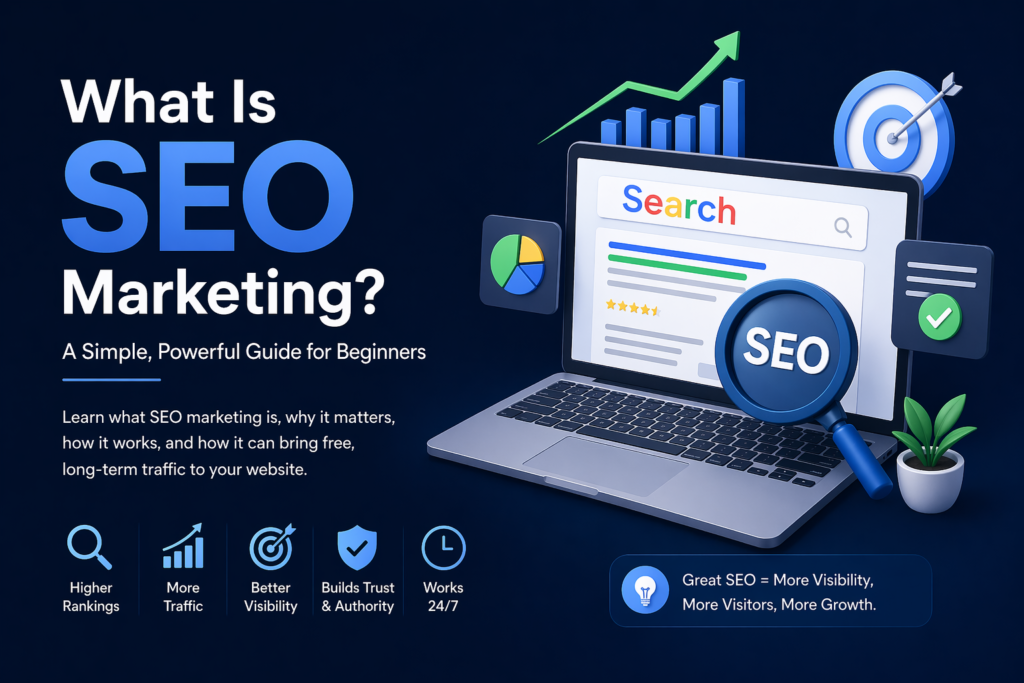
SEO marketing (Search Engine Optimization marketing) is the process of improving your website so it appears higher in search engine results like Google or Bing — without paying for ads.
When someone types a question into Google, the search engine scans millions of websites and ranks them based on relevance, quality, and authority. SEO marketing helps your website become one of those top results.
In short: SEO marketing = getting free, organic traffic from search engines by making your website more visible and trustworthy.
Why Does SEO Marketing Matter?
Think about your own habits. How often do you go past the first page of Google results? Rarely, right?
Here’s why SEO marketing is worth your attention:
- Over 68% of all online experiences begin with a search engine
- The top 3 Google results get more than 50% of all clicks
- Organic (non-paid) traffic is free and sustainable over the long term
- It builds trust and credibility with your audience
- SEO works 24/7 — even while you sleep
The 3 Core Pillars of SEO Marketing
SEO marketing rests on three main foundations. Think of them as the legs of a stool — all three need to be strong.
1. On-Page SEO
This is everything you do on your website to make it search-friendly.
- Using the right keywords in your content
- Writing clear, helpful titles and headings
- Optimizing meta descriptions (the short summaries under Google links)
- Adding alt text to images
- Creating high-quality, original content
2. Off-Page SEO
This is what happens outside your website to build its authority.
- Getting backlinks (other websites linking to yours)
- Building your social media presence
- Being mentioned or reviewed on other platforms
- Guest posting on reputable websites
3. Technical SEO
This is the behind-the-scenes work that helps search engines crawl and index your site properly.
- Making your site mobile-friendly
- Improving page loading speed
- Setting up a clean URL structure
- Using SSL certificates (the padlock in your browser bar — https://)
- Creating an XML sitemap
How SEO Marketing Works: Step-by-Step
Here’s how a basic SEO marketing process looks:
1: Keyword Research
Find out what words and phrases your target audience is searching for. Tools like Google Keyword Planner or Ubersuggest can help.
2: Content Creation
Write helpful, well-structured content that answers your audience’s questions. Focus on quality, not just quantity.
3: On-Page Optimization
Place your target keywords naturally in your title, headings, and body content. Avoid stuffing keywords unnaturally — Google penalizes this.
4: Technical Fixes
Make sure your site loads fast, works on mobile, and has no broken links.
5: Build Backlinks
Reach out to other websites, write guest posts, or create content so good that people naturally link to it.
6: Track and Improve
Use free tools like Google Search Console and Google Analytics to monitor your progress and keep improving.
SEO Marketing vs. Paid Advertising: A Quick Comparison
| Feature | SEO Marketing | Paid Ads (PPC) |
|---|---|---|
| Cost | Free (time investment) | Pay per click |
| Results timeline | 3–6 months | Immediate |
| Sustainability | Long-term | Stops when budget stops |
| Trust factor | Higher (organic) | Lower (labeled “Ad”) |
| Best for | Long-term growth | Quick campaigns |
Both have their place, but SEO marketing offers more sustainable, compounding results over time.
Common SEO Marketing Mistakes to Avoid
Even well-meaning marketers make these errors:
- Keyword stuffing — Repeating keywords too many times makes content unreadable and hurts rankings
- Ignoring mobile users — Google ranks mobile-friendly sites higher
- Slow page speed — A site that takes more than 3 seconds to load loses visitors fast
- Thin content — Short, low-value pages don’t rank well
- Skipping meta descriptions — These are your “ad copy” in search results; don’t leave them blank
- Buying cheap backlinks — Low-quality links can get your site penalized
How Long Does SEO Marketing Take?
This is one of the most common questions — and the honest answer is: it takes time.
- 0–3 months: Technical fixes, content creation, initial indexing
- 3–6 months: You start seeing ranking improvements
- 6–12 months: Significant traffic growth becomes visible
- 12+ months: Compounding results and stronger authority
SEO is not a sprint — it’s a marathon. But the results are worth the patience.
Frequently Asked Questions (FAQs)
Q: Is SEO marketing free?
A: The organic traffic itself is free, but there are costs involved in tools, content creation, and sometimes hiring an SEO specialist.
Q: Can I do SEO marketing myself?
A: Yes! Many small business owners learn and apply basic SEO themselves. However, for competitive industries, professional help can speed up results significantly.
Q: What’s the difference between SEO and SEM?
A: SEO (Search Engine Optimization) focuses on organic rankings. SEM (Search Engine Marketing) is a broader term that includes both organic SEO and paid advertising like Google Ads.
Q: Does social media affect SEO?
A: Social media doesn’t directly impact rankings, but it helps amplify your content, increase brand visibility, and drive traffic — all of which can support your SEO efforts.
Q: How do I know if my SEO is working?
A: Track metrics like organic traffic, keyword rankings, bounce rate, and conversion rate using Google Analytics and Google Search Console.
Q: Is SEO still relevant in 2025?
A: Absolutely. Search engines are still the #1 way people discover new websites and businesses. SEO continues to evolve but remains one of the highest-ROI digital marketing channels.
Conclusion
SEO marketing is one of the smartest long-term investments you can make for your online presence. It’s not about tricking search engines — it’s about creating a genuinely useful, well-structured website that both people and search engines love.
Whether you’re a blogger, small business owner, or growing brand, understanding and applying SEO marketing can be the difference between being invisible online and consistently attracting the right audience.
Start small, stay consistent, and remember: every great website ranking started with a single optimized page.